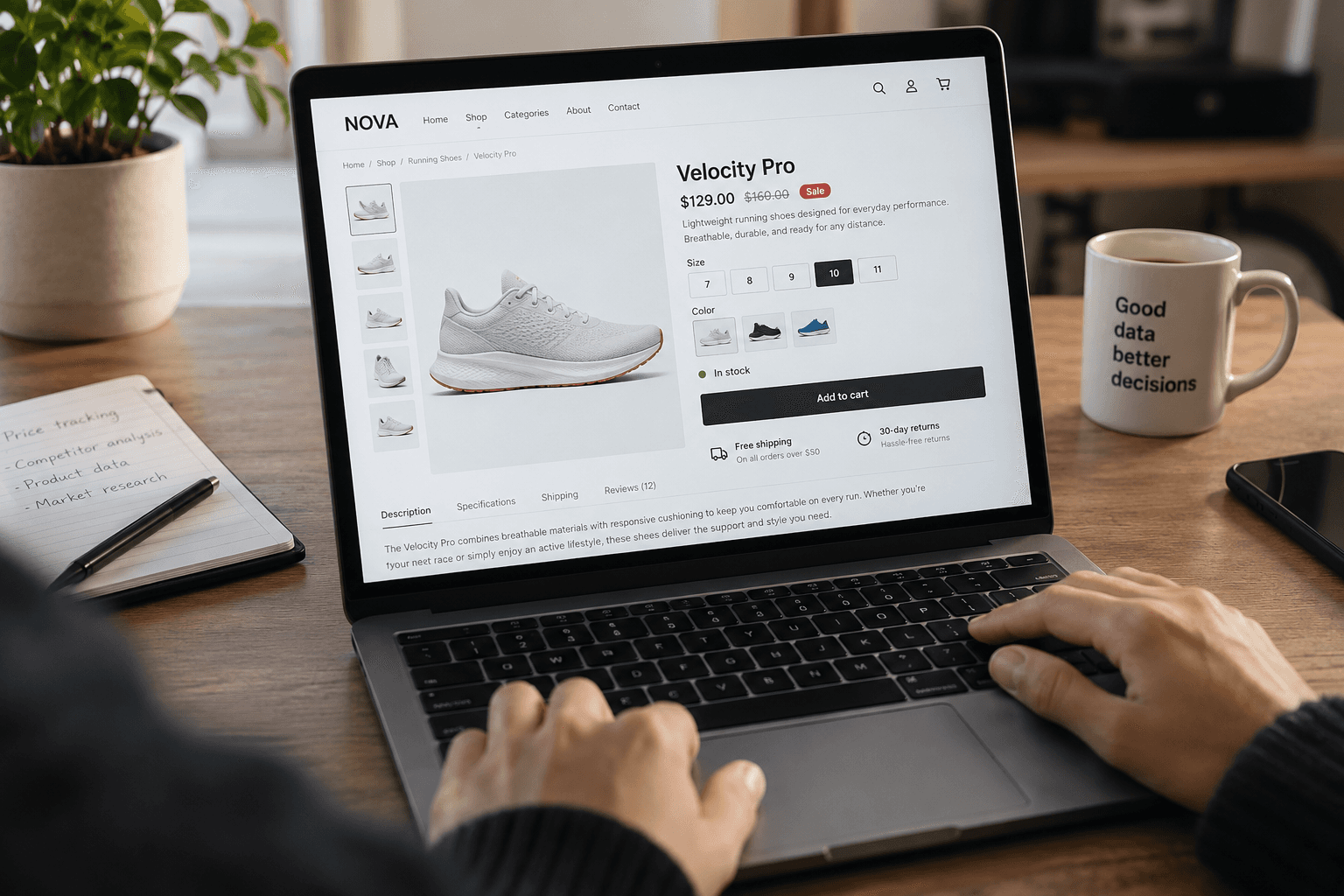

Your pricing dashboard says a competitor sells your best-selling dish soap 45% cheaper. The repricing rule fires, your margin drops, and a week later someone notices the problem: the competitor listing was a 6-pack, and yours is a 12-pack. The scraper did its job. The price was collected correctly. It was simply attached to the wrong product.
This is the problem product matching solves. In competitor price monitoring, every number is only as good as the pair it belongs to. Collecting competitor prices is the visible part of the work. Deciding which competitor listing is actually your product is the part that decides whether the data can be trusted.
In this guide we explain what product matching in ecommerce is, why price data fails without it, how matching methods work from exact identifiers to AI, and which product data you need to collect so matching works at all. If you are building a competitive pricing strategy, this is the step that comes before every price decision.
What is product matching?
Product matching is the process of identifying the same product across different online stores, marketplaces or catalogs, even when each seller names, describes and structures it differently. The output is a set of linked pairs: your SKU and the competitor listing that represents the identical item. Those pairs are what you compare on price, stock and promotions.
In practice, there are two kinds of product matches:
Exact matches. The same brand, model, variant and pack size. Only exact matches belong in a price comparison.
Comparable matches. A different product that competes for the same shopper, such as a private-label alternative or a similar model from another brand. These are useful for assortment and positioning, but they should be labeled separately and never mixed into price gaps.
Product matching is also different from deduplication. Deduplication finds repeated items inside one catalog, for example when two supplier feeds describe the same product. Matching products works across sources. The techniques overlap, but the goal is different: matching tells you who else sells what you sell, and at what price.
Why price data fails without product matching
A competitor price on its own means nothing. It becomes competitor pricing data only when it is tied to the right product on your side. When that link is wrong or missing, the errors don't stay in one cell. They spread into every report, rule and alert built on top.
The wrong-pair problem
Most bad pricing decisions don't come from scraping errors. They come from comparing two products that look alike but are not the same.
Your product | Competitor listing | What the comparison shows | What is really happening |
|---|---|---|---|
Dish soap, 12-pack | Same soap, 6-pack | Competitor is 45% cheaper | Per unit, the competitor is more expensive |
Smartphone, 256 GB | Same model, 128 GB | Competitor is $120 cheaper | Different variant, different price tier |
Headphones, 2026 model | Previous generation on clearance | You look overpriced | The old model is being sold off |
Laptop, new | Same laptop, refurbished | Competitor undercuts you | Different condition and warranty |
Coffee machine | Same machine + milk frother bundle | Competitor looks expensive | The bundle includes an extra product |
Kettle, EU version | Kettle, UK version | Small price gap | Different plug, certification and warranty |
Illustrative examples.
In each case the scraped price is correct. The decision based on it is not.
Variants, pack sizes and units
Many product pages show one price for the default variant, while the shopper may choose another size or color with a different price. Multipacks and weights add another layer. A 750 ml bottle and a 1 l bottle can only be compared after the price is converted to a price per unit. Without variant-level matching and unit normalization, competitive price analysis compares numbers that were never meant to be compared.
Unmatched products are invisible competitors
Wrong matches are loud. Missing matches are silent. If a competitor sells your product under a different title and your system fails to connect the two, that competitor simply disappears from your reports. The dashboard looks calm, and you assume you are the cheapest on items where you have no coverage at all. A low match rate is often more dangerous than a few wrong pairs, because nobody notices it.
How one bad match breaks the price index
A price index averages the gap between your prices and competitor prices across matched products. One wrong pair with a 50% gap can shift the index for a whole category, especially for key value items with few competitors. The damage multiplies when the data drives automation:
Repricing rules lower prices to match a product that isn't the same one.
Minimum advertised price monitoring flags resellers for violations they didn't commit, which damages brand and partner relationships.
Competitor price analysis reports trends that are really changes in which listings got matched.
This is why reliable competitor price monitoring starts with the question "is this the same product?" before it asks "what does it cost?"
Where product matching is used in e-commerce
Price comparison is the best-known use case, but ecommerce product matching sits underneath most work with competitor data.
Price monitoring and repricing. Every price gap, price index and repricing rule depends on matched pairs. This is the core of pricing intelligence.
Minimum advertised price monitoring. Brands need to find their own products on dozens of reseller sites, often listed under different titles and without the brand's SKU. MAP checks are only fair when each listing is matched to the right model and variant.
Assortment intelligence. To see which products competitors carry that you don't, you first need to know where your catalogs overlap. Matching separates shared products from true assortment gaps. More on this in assortment analysis.
Marketplaces and Amazon product matching. On Amazon, many sellers offer the same product under one ASIN, and new offers are attached to existing catalog pages by identifiers such as UPC or EAN. For brands and retailers, the task is the reverse: link your own catalog to the right ASINs so you can see every offer and the Buy Box price.
Stock and availability tracking. A competitor stockout is only useful if you know it affects a product you sell. See how to track product stock availability across competitor stores.
Catalog import and enrichment. When you import supplier catalogs or fill gaps in product content, matching prevents duplicates and helps attach the right specs and images to the right SKU. Related reading: product data enrichment and catalog import.
Price comparison software. Comparison sites and shopping engines are matching systems at heart. Web scraping for price comparison collects the offers; matching decides which offers appear on the same product page.
How product matching works: from exact to fuzzy
No single product matching algorithm handles every catalog. Practical systems use a cascade: they try the most reliable method first and fall back to looser methods only for products that are still unmatched.
1. Identifier matching (GTIN, EAN, UPC, MPN, ASIN)
Global Trade Item Numbers are the strongest signal. UPC (12 digits) is common in North America, EAN-13 in most other markets, and both belong to the GTIN family. MPN, the manufacturer part number, works well together with the brand. ASIN identifies a product inside Amazon.
When both sides expose the same GTIN, the match is fast and almost always correct. The limits are practical: many stores don't show GTINs on the page, some hide them in structured data, and some use wrong or reused codes. An MPN can also be shared by several variants of one model.
2. Brand + model + key attributes
When identifiers are missing, the next best signal is a normalized brand, a model number extracted from the title, and the attributes that decide identity: size, capacity, color, pack count, condition. Two listings with the same brand and model but different capacity are not a match, however similar they look.
3. Fuzzy title and attribute similarity
This is the classic text approach. Titles are cleaned and split into tokens, then compared with string or token similarity scores. It catches products that are named differently, such as reordered words or added marketing phrases. It needs guardrails: a 95% similar title with a different size is still a different product.
4. Image and AI matching
Product matching AI uses embeddings of titles, descriptions and images to find candidates that text rules miss. Language models can also compare two candidate listings and judge whether they describe the same item. This helps most in the long tail, fashion and private label. AI needs confidence thresholds and audit samples, because a confident wrong answer looks exactly like a right one.
5. Human review for low-confidence pairs
Pairs below the confidence threshold go to a reviewer. Their decisions become training data and rules for the next run, so the share of manual work falls over time.
Method | Precision | Coverage | Best for | Main risk |
|---|---|---|---|---|
Identifiers (GTIN, MPN, ASIN) | Very high | Low to medium | Electronics, branded goods, marketplaces | Missing or wrong codes |
Brand + model + attributes | High | Medium | Products with clear model numbers | Model numbers hidden in free text |
Fuzzy title similarity | Medium | High | Inconsistent naming | Look-alike variants |
Image and AI matching | Medium to high | High | Long tail, fashion, private label | Confident errors |
Human review | Highest | Lowest | Key value items, edge cases | Cost and speed |
Each match should carry a confidence score and the method that produced it. Pricing rules can then act automatically on high-confidence pairs and wait for review on the rest. For where matching fits in a full pipeline, see our guide to building a real-time competitor price monitoring system.
Why product matching is hard in practice
On paper, product matching in ecommerce sounds like a lookup. In real catalogs it rarely is.
Identifiers are hidden or missing. Many retailers remove GTINs from the visible page, and marketplaces often show them only for some sellers.
Titles follow no standard. One store writes "Brand X Series 4 Dishwasher AB123, 60 cm, Stainless", another writes "AB123 Free-Standing Dishwasher by Brand X". Same product, almost no shared word order.
Variants multiply the problem. One product page can hold 20 size and color combinations, each with its own price and stock.
Multipacks and bundles. "2 x 500 g", "1 kg value pack" and "500 g + free sample" may or may not be the same offer.
Private label and regional versions. A store's own brand has no counterpart to match exactly, and a product sold in two countries may differ in plug, packaging or warranty.
Catalogs change. Competitors re-title listings, change URLs and reuse pages for new models. A match that was right last month can be wrong today.
Grocery is the hardest case. Weights vary ("approx. 450 g"), promotional packs appear and disappear, and private label makes up a large share of shelves. That is why grocery product matching is often handled by specialized companies and dedicated teams.
For more on why collecting e-commerce data became an engineering problem, read Ecommerce Web Scraping in 2026.
Good matching starts with good data: what to collect
Every matching method, from GTIN lookup to AI, is limited by the data it receives. If the scraper only captures a title and a price, the only option left is fuzzy text matching, the least reliable layer. Collect the fields below from every competitor product page, at variant level wherever the page allows it.
Field | Why it matters for matching |
|---|---|
GTIN / EAN / UPC | Exact identity across stores |
MPN and brand | Strong match when GTIN is missing |
ASIN or marketplace ID | Links listings inside a marketplace |
Retailer SKU | Tracks the same listing over time |
Title and model number | Input for attribute and fuzzy matching |
Variant attributes (size, color, capacity) | Separates look-alike variants |
Pack size, quantity, weight, unit | Enables price-per-unit comparison |
Condition (new, refurbished, used) | Prevents mixing different offers |
Price, list price, currency, promo label | The value you compare once matched |
Category path | Narrows the search for candidates |
Main image URL | Input for image matching |
Product URL and timestamp | Audit trail and re-checks |
Raw fields also need normalization before matching:
Units converted to one standard (ml and l, oz and g).
Currencies converted, with the rate date stored.
Brand aliases unified, such as "HP" and "Hewlett-Packard".
Attributes hidden in titles or descriptions parsed into separate columns.
This is the layer ShopScraping covers. ShopScraping doesn't match products for you. It delivers the structured, identifier-rich data that matching depends on. With product data extraction, you get identifiers such as GTIN/EAN/UPC, MPN and ASIN, brand, variant attributes and specifications in clean columns. Price scraping keeps prices, discounts and promotions at variant level. The full list of standard and custom data fields is in our knowledge base, and the data comes as CSV, Excel or JSON, ready to load into your own matching rules or a matching tool.
How to measure product matching quality
You can't improve what you don't measure. Four metrics tell you whether your matches can be trusted.
Precision. The share of matched pairs that are actually correct. Check it by sampling: take a random set of pairs per competitor and review them by hand.
Match rate (coverage). The share of your SKUs that have a confirmed match at each competitor. A low rate means blind spots in your reports.
Review share. The share of pairs that need manual checks. It should fall over time as rules and models learn.
Freshness. How long ago each match was confirmed. Re-check pairs when a listing changes its title, identifier or URL, or disappears.
Track these metrics by competitor, category and matching method. Precision for GTIN matches and for AI matches can be very different, and an average hides that. For key value items, set a stricter confidence threshold and review every new match before it feeds pricing rules.
Build in-house or use a product matching solution?
A competitor pricing workflow has three layers: collecting the data, matching products, and analyzing prices. They don't have to come from one vendor. Many teams combine a data provider for collection with their own matching rules, or with dedicated product matching software or services.
Factor | In-house matching tends to fit | A product matching solution tends to fit |
|---|---|---|
Catalog size | Hundreds to a few thousand SKUs | Tens of thousands of SKUs and up |
Identifiers | Most competitors show GTIN or MPN | Identifiers are rare, text and images dominate |
Categories | Branded goods with clear model numbers | Fashion, grocery, private label |
Team | A data analyst or engineer is available | No technical capacity for maintenance |
Control | You need full control of rules and logic | You need speed more than custom logic |
Whichever way you choose, the matching layer can only be as good as its input. A product matching solution fed with titles and prices alone will still struggle. The same tool fed with identifiers, variant attributes and pack sizes will match more products with fewer errors.
For a wider look at the trade-offs of running your own data pipeline, see Build vs Buy: Do You Really Need to Build Your Own Competitor Data Pipeline?
Getting started
You don't need a perfect system on day one. A simple, reliable process beats a clever one that nobody trusts.
Pick competitors and priority SKUs. Start with your key value items and the 3 to 5 competitors your shoppers compare you with.
Collect complete product data. Capture identifiers, brand, model, variant attributes, pack sizes and prices, not just titles and prices.
Match by identifiers first. Then add brand, model and attribute rules for the rest.
Review what's left. Check low-confidence pairs by hand and turn your decisions into rules.
Only then analyze prices. Build price indexes, alerts and repricing rules on confirmed matches only.
ShopScraping handles step 2. Point it at competitor stores and get structured product data with identifiers and variant-level prices on a schedule, without code or infrastructure. Run a demo on any product page, see how competitor price monitoring works with ShopScraping, or contact us to discuss your catalog.
FAQ
What is product matching in ecommerce?
Product matching in ecommerce is the process of linking the same product across different stores and marketplaces, even when each seller lists it under a different title, description or ID. Matched pairs make it possible to compare competitor prices, stock and promotions like for like.
What is the difference between product matching and price matching?
Product matching identifies which competitor listing is the same item as yours. Price matching is a pricing policy: a store agrees to match a lower price that a shopper finds elsewhere. Price matching software automates that policy, and it depends on product matching to confirm that the cheaper offer is really the same product.
Can you match products without GTIN or EAN codes?
Yes. When identifiers are missing, matching relies on brand, model number and key attributes, then on title similarity, image comparison and AI. Accuracy is lower than with identifiers, so these matches need confidence scores and review for important products.
How does Amazon product matching work?
Amazon groups offers from many sellers under one catalog page with one ASIN. New offers are usually attached to an existing ASIN by UPC, EAN or another identifier. For sellers and brands, matching means linking their own SKUs to the right ASINs so they can track every offer for the product.
How accurate is AI product matching?
It depends on the category and the input data. AI handles inconsistent titles and long-tail products well, but it can make confident mistakes, especially between close variants. Use it after identifier and attribute matching, with thresholds and regular sample checks.
How often should product matches be updated?
Check matches whenever a competitor listing changes its title, identifier or URL, or goes offline. For fast-moving categories, re-validate priority products weekly. Collecting product data on a schedule makes these changes visible.
Is it legal to collect competitor product data for matching?
Collecting publicly available product information is generally lawful in many jurisdictions, but rules depend on the site and the country. See our guide Is Web Scraping Legal?