
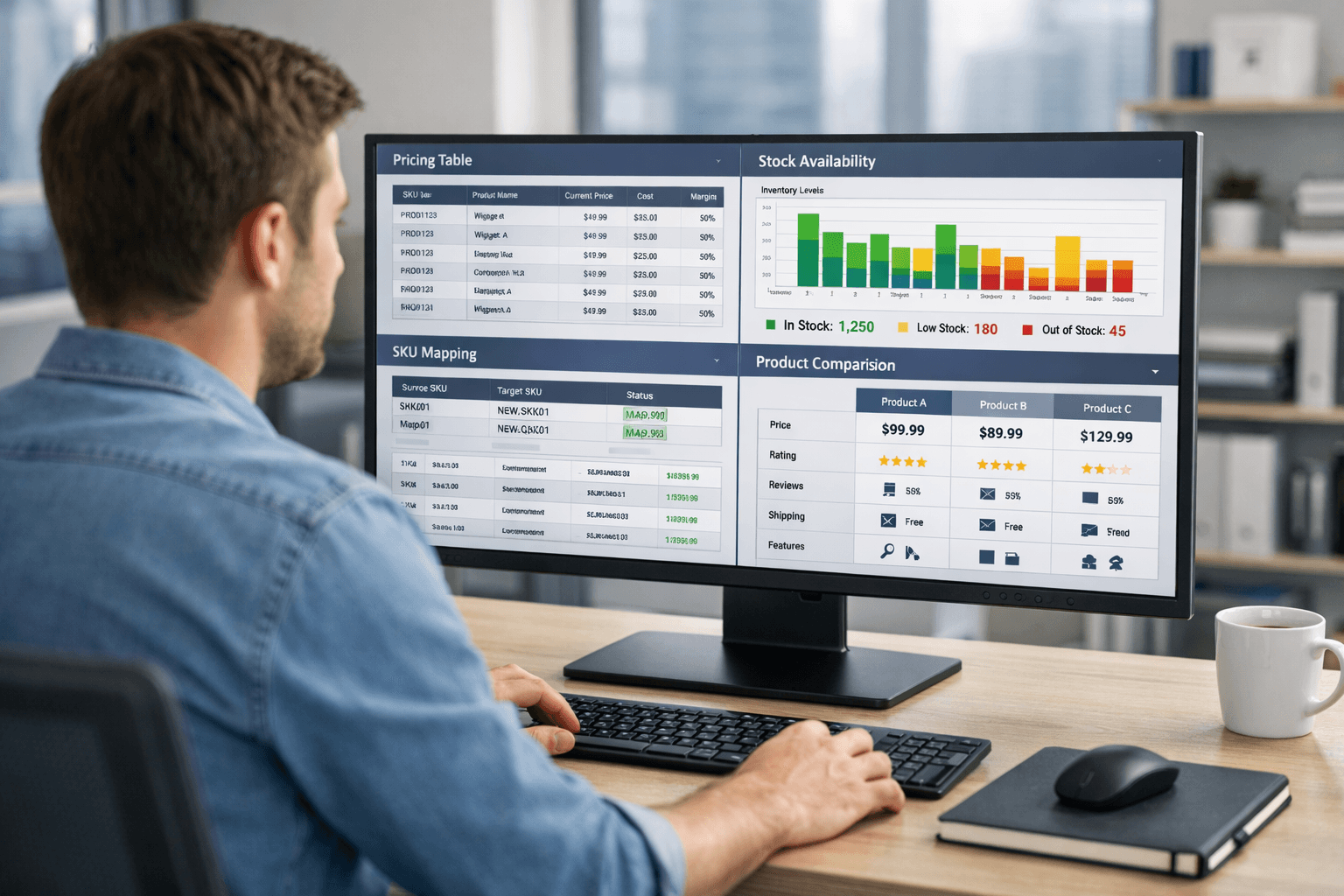
By 2026, ecommerce is no longer a static catalog of products with predictable pricing. Prices change multiple times per day, search results are personalized, and even product availability depends on location, device, or user behavior.
In this environment, data is not just useful — it is operationally critical. Companies rely on it for pricing decisions, assortment planning, and competitive analysis. But collecting that data has become significantly more difficult than it used to be.
This article explains why.
Why Ecommerce Data Became So Hard to Collect
A decade ago, scraping ecommerce websites was relatively straightforward: request a page, parse the HTML, extract the fields.
That model no longer works.
Most modern ecommerce platforms are built as dynamic applications. Content is rendered in the browser, often differently for each session. The same product page can show different prices, promotions, or availability depending on:
location
device type
cookies and session history
traffic source
Search results are even less predictable. Ranking is influenced by personalization algorithms, meaning two users may see entirely different product orders.
At the same time, anti-bot systems have evolved. Instead of simply blocking suspicious requests, they analyze behavior across many signals — how a page is loaded, how a user navigates, how consistent a session appears.
As a result, scraping today is less about “downloading pages” and more about replicating realistic user behavior at scale.
What a Modern Scraping System Actually Needs
Because of these changes, reliable data collection requires more than just scripts or parsers. It becomes a system with three core responsibilities.
1. Data Collection in Dynamic Environments
Some data can still be accessed via APIs or simple HTTP requests. But many ecommerce sites rely heavily on JavaScript, requiring full browser execution.
This means systems often need to:
render pages like a real browser
interact with elements (scrolling, clicking)
manage navigation flows
extract data after dynamic content loads
In practice, efficient setups combine both approaches: using browsers where necessary, and switching to direct API calls when possible.
2. Identity and Anti-Detection Management
The hardest part of modern scraping is not extraction — it is staying undetected.
Websites evaluate requests using a wide range of signals, including network characteristics, browser configuration, and behavioral patterns. Simply rotating IP addresses is no longer sufficient.
Reliable systems simulate consistent “identities”, which include:
IP and location
browser characteristics
cookies and session state
realistic navigation behavior
They also distribute activity across regions to capture local pricing and availability differences.
At scale, this becomes a probabilistic problem: collect as much data as possible while minimizing the risk of being blocked or receiving distorted results.
3. Turning Raw Data into Usable Data
Even when data is successfully collected, it is rarely ready for analysis.
Different retailers structure information differently. Product names vary, attributes are inconsistent, and duplicates are common.
Processing pipelines typically handle:
cleaning and structuring raw data
matching identical products across sites
normalizing brands, categories, and attributes
converting currencies and units
Machine learning is increasingly used here — especially for product matching and extracting structured information from unstructured descriptions.
Without this layer, scraped data has limited practical value.
The Core Challenges in 2026
Even with proper systems in place, several challenges remain fundamental.
Anti-Bot Systems
Modern defenses often do not block aggressively. Instead, they degrade data quality — for example, by hiding products, altering rankings, or delaying responses.
This makes detection harder: the system may appear to work while returning incorrect data.
Personalization
Two identical requests can produce different results.
For analytics and pricing models, this creates a reproducibility problem. Systems must control for session state and context, or explicitly track it.
Geographic Variability
Prices, taxes, and availability differ across regions.
Accurate analysis requires precise control over:
geolocation
currency
language
store or delivery settings
Without this, comparisons become unreliable.
Constant Frontend Changes
Ecommerce sites update frequently. Small UI changes can break extraction logic.
Robust systems rely less on fragile page structure and more on stable signals such as embedded structured data or adaptive extraction strategies.
Some platforms make this easier than others. Stores built on Shopify share one product model and a predictable URL scheme, so a stable signal is usually available even after a theme change — we go through what that looks like in practice in how to scrape a Shopify store. Custom-built storefronts offer no such guarantee, which is why adaptive extraction matters more there.
Legal and Compliance Constraints
Scraping operates within a complex regulatory environment.
Organizations need to consider:
terms of service
data usage policies
privacy regulations (e.g., GDPR)
responsible request patterns
This is increasingly part of system design, not just legal review.
What Companies Use This Data For
Despite the complexity, demand for ecommerce data continues to grow because of its direct business impact.
The most common applications include:
Competitive pricing
Tracking competitor prices and promotions to adjust pricing strategies.
Assortment analysis
Understanding competitor catalogs, identifying gaps, and monitoring trends.
Product matching and benchmarking
Comparing identical products across platforms to build pricing indexes and market insights.
MAP compliance
Detecting unauthorized discounting across marketplaces.
Review and sentiment analysis
Analyzing customer feedback to identify issues and opportunities.
Inventory monitoring
Tracking stock availability as a signal of demand and supply dynamics.
From Scripts to Infrastructure
One of the most important shifts is conceptual.
Scraping is no longer a collection of scripts. It behaves more like a data infrastructure layer:
distributed
continuously running
monitored and optimized
integrated into downstream systems
This shift also changes the cost structure. The main expenses are no longer development time, but ongoing operation: infrastructure, proxy networks, and data processing.
Efficiency comes from selectivity — collecting only what is needed, when it is needed.
The Direction of the Market
Several trends are becoming clear:
Anti-bot systems are increasingly driven by machine learning
Personalization continues to grow, reducing determinism
Legal frameworks are tightening, especially across regions
Automation in data extraction and processing is improving
At the same time, maintenance is becoming more automated. Systems are better at detecting failures, adapting to changes, and recovering without manual intervention.
ShopScraping handles this layer for you
If your team needs reliable competitor pricing data without building or maintaining scraping infrastructure, ShopScraping collects, processes, and delivers structured e-commerce datasets on a regular schedule — so you can focus on analysis and decisions rather than engineering. See how it works.
Conclusion
Ecommerce web scraping in 2026 is no longer a simple technical task. It is a complex, evolving engineering problem shaped by dynamic frontends, anti-bot systems, and fragmented data environments.
The value of ecommerce data has increased — but so has the cost of obtaining it reliably.
Understanding this gap is essential for anyone working with pricing, analytics, or competitive intelligence in modern ecommerce.