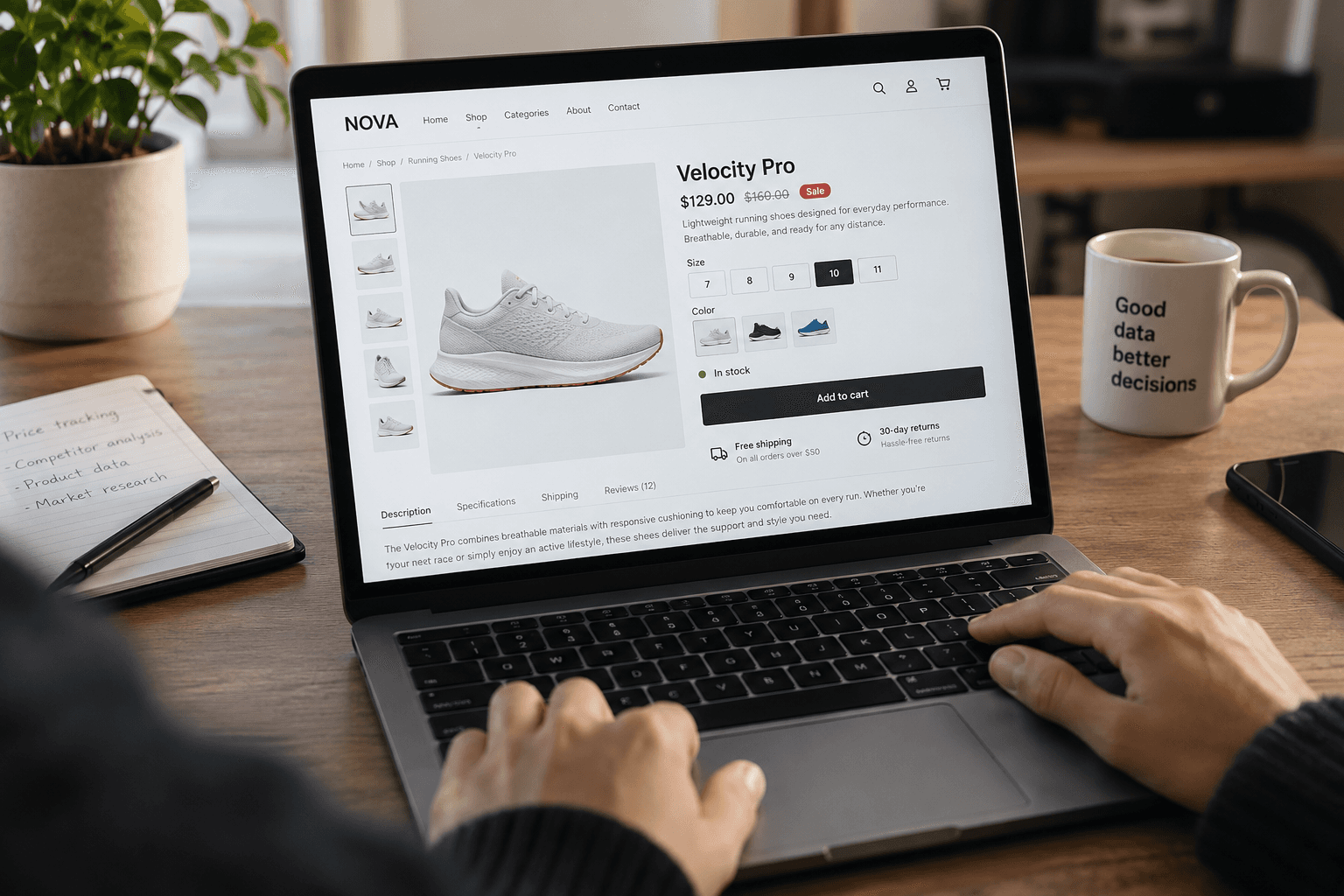

Every retailer checks competitor prices. Very few turn those checks into a pricing advantage.
The difference is rarely the amount of data. It is what happens after the data arrives. Competitor prices do not set your prices on their own. They feed a competitive pricing strategy, and the strategy sets the prices.
Retailers who win on price understand this. They know which products shoppers actually compare, where they can charge more without losing sales, and when a competitor's discount is worth answering. They are not always the cheapest. They are cheapest where it counts.
This guide covers how retailers use competitor data in practice:
what competitor-based pricing really means and when it fits
why the lowest price is rarely the winning one
seven concrete ways retailers act on competitor data
competitive pricing examples you can adapt
the metrics that show whether it's working
the data each play needs, and the mistakes that lead to a price war
If you're looking for how to collect competitor prices, start with our guide on how to monitor competitor prices without integrations. This article is about what to do with them.
What competitor-based pricing actually means
Competitor-based pricing (also called competition-based pricing) means setting your prices with competitor prices as the main reference point. You still know your costs and your margins. But the number the shopper sees is anchored to what the same product costs elsewhere.
It is one of three classic approaches:
Approach | Price is anchored to | Works best when |
|---|---|---|
Cost-plus pricing | Your cost + a target margin | Products are unique or hard to compare |
Value-based pricing | What the customer is willing to pay | You have a strong brand or clear differentiation |
Competitor-based pricing | What competitors charge for the same item | Shoppers can find the identical product in other stores |
In practice, most retailers mix all three. A store selling branded electronics lives on competitive pricing, because the same TV model is one search away in a dozen shops. Its private-label cables and accessories can follow cost-plus or value-based logic, because nobody can compare them like-for-like.
That is the first decision in any competitive pricing strategy: decide which part of your catalog is priced against competitors at all. Usually it is the part where shoppers compare. For the rest, competitor data is context, not a rule.
Competitive pricing also does not mean "match everyone." It means you consciously choose your position relative to the market for each product group: below, at, or above. We'll come back to that choice below.
Why winning on price rarely means being the cheapest
Shoppers don't compare every price. They remember a handful and judge the whole store by them. That impression is price perception, and it matters more than your average price level.
The products that shape it are called key value items (KVIs): popular, frequently bought, easy-to-compare products where shoppers know the going rate. Think of a best-selling phone model, a popular coffee machine, or the standard pack of a leading diaper brand. Being expensive on those makes the store feel expensive, even if everything else is cheap.
The flip side is the long tail. On niche items, accessories and products shoppers rarely compare, a few percent above market rarely costs a sale. That is where margin is made.
So winning on price looks like this:
Sharp on KVIs, where shoppers are watching
At market on the bulk of the comparable catalog
Above market where you have an edge: availability, delivery speed, bundles, service
Retailers that ignore this and simply undercut everyone end up in a price war. Competitors' automated systems react to yours, prices spiral down together, and everyone gives away margin that shoppers would have paid anyway. Competitor data used well does the opposite. It tells you where you don't need to cut.
7 ways retailers use competitor data to win on price
Each play below answers a different pricing question. For each one: what it is, the competitor data it needs, and how often that data has to refresh.
1. Protect price perception on key value items
Identify your 50–200 KVIs and keep them at or below your main competitors' prices. Check them first and most often. A gap on a KVI hurts more than gaps on a thousand long-tail products.
Data needed: current price, promo price and availability for each KVI at 3–5 core competitors
Refresh: daily, several times a day in fast categories like electronics
2. Choose your price position: below, at or above market
For every category, decide a target position: for example, 3% below the market on KVIs, at market on comparable items, 5% above on items where you offer faster delivery. Competitor data turns that decision into numbers you can check.
Data needed: matched competitor prices across the category, to calculate your average gap per product group
Refresh: weekly is enough for most catalogs; daily for volatile categories
3. Run rule-based and dynamic repricing
Once positions are set, rules apply them at scale. "Stay 1% below Competitor A, but never below a 12% margin." "Match the lowest of three competitors on KVIs only if they are in stock." This is dynamic pricing in retail in its practical form: not an algorithm guessing demand, but your strategy executed automatically.
Data needed: reliable, matched competitor prices with timestamps; stock status, so you don't match a price nobody can actually buy at
Refresh: as often as your rules run; stale data plus automatic rules is how pricing errors scale
4. Respond to competitor promotions without overreacting
Not every competitor discount needs an answer. A one-day flash sale on an item you sell few of can be ignored. A permanent price drop on a top-10 KVI cannot. Tracking regular price and promo price separately is what lets you tell the two apart.
Data needed: regular vs. sale price, promo labels, promotion start and end dates, price history
Refresh: daily, with competitor price tracking history kept for trend analysis
5. Capture demand when competitors go out of stock
When a key competitor runs out of a popular product, shoppers look elsewhere. That's a moment when you can hold your price, or even raise it slightly, instead of discounting. It's also a signal to push ad spend on that item.
Data needed: in-stock / out-of-stock status, delivery times, sometimes stock levels
Refresh: daily or more often during peak season
We cover this in detail in how to track product stock and availability across competitor stores.
6. Enforce MAP and catch reseller violations
This play is for brands and distributors rather than pure retailers. If you set a minimum advertised price (MAP), you need to know which resellers and marketplace sellers advertise below it. Minimum advertised price monitoring protects your brand's value and your compliant resellers' margins.
Data needed: advertised price, seller name, URL and a timestamped record as evidence
Refresh: daily; screenshots or stored page data help when you contact a reseller
7. Spot assortment and price gaps
Competitor data shows more than prices. Comparing catalogs reveals products competitors sell that you don't, products only you carry (where you have pricing freedom), and categories where a competitor is consistently cheaper across the board. This kind of competitive price analysis often finds more margin than any repricing rule.
Data needed: full competitor category listings, not just matched SKUs: titles, brands, prices, attributes
Refresh: monthly or quarterly
Competitive pricing examples
The scenarios below are illustrative, based on common situations in e-commerce. Each one shows the same pattern: a pricing question, the competitor data that answers it, and the decision.
Example 1: Electronics store protecting its KVIs
Situation. A mid-sized electronics retailer tracks about 4,000 products. Customer surveys show shoppers see the store as "a bit expensive," even though its average prices are close to the market.
Data. Daily prices for its top 150 sellers at four main competitors. The analysis shows the store is 4–7% more expensive on 30 of its most-searched products: flagship phones, popular headphones, game consoles.
Decision. The retailer moves those 30 products to the lowest competitor price (in stock) and raises prices by 2–3% on 600 accessories and cables where no competitor sells the same items. Overall margin stays flat; the store now looks cheap where shoppers look.
Example 2: Home appliances retailer ignoring the wrong promotions
Situation. A home appliances store matches every competitor discount automatically. Margin is falling, and sales of matched items barely move.
Data. Six months of competitor price history, with regular and sale prices tracked separately. It shows that most competitor discounts last under 72 hours and target low-volume models.
Decision. New rule: match only discounts that last more than 3 days, on products in the top 20% by revenue. The number of price changes drops sharply, and so does the margin leak.
Example 3: Brand enforcing MAP across marketplaces
Situation. A kitchenware brand sells through 40 online resellers. Its best retailers complain that marketplace sellers undercut them.
Data. Daily advertised prices for the brand's 120 products across reseller sites and marketplace listings, with seller names and timestamps.
Decision. The brand contacts sellers advertising below MAP with dated evidence. Most correct their prices; repeat violators lose access to new products. Its authorized retailers stop discounting to compete.
Example 4: Online store using competitor stockouts
Situation. A sporting goods store notices that sales of a popular running shoe jump on some weeks for no clear reason.
Data. Availability tracking shows the jumps line up with a large competitor running out of popular sizes.
Decision. When the competitor is out of stock, the store holds full price instead of joining discounts, and increases ad spend on that model. When the competitor restocks, it returns to its normal position.
Metrics that show if you're winning on price
A strategy you can't measure turns into guesswork. Five metrics cover most of what a pricing team needs.
Competitive price index. Your price divided by a reference competitor price (the lowest, the average, or a chosen rival), times 100. An index of 100 means you're at market; 97 means 3% below; 105 means 5% above. Calculate it per product, then weight it by revenue for categories and the whole store.
Price index = (Your price ÷ Reference competitor price) × 100
Price gap distribution. The share of matched products where you are cheaper, equal, or more expensive than the market. An average index of 100 can hide 20% of products that are 10% too expensive.
KVI position. Your price index on KVIs alone. This is the number that tracks price perception, so it deserves its own line in every report.
Competitor price change frequency. How often each competitor changes prices, by category. It tells you who runs automated repricing and how often you need fresh data.
Data coverage and freshness. The share of your target products with a valid, matched competitor price no older than your refresh window. Every other metric depends on this one.
Together these form the core of competitor pricing analysis. Track them weekly and compare them with sales and margin. If your index goes down and sales don't move, you're cutting prices nobody asked for.
What competitor data you need (and where it comes from)
Each play above needs different data at a different speed. Before you collect anything, map your strategy to its data requirements:
Play | Key fields | Refresh | Scope |
|---|---|---|---|
KVI protection | Price, promo price, in stock | Daily or faster | 50–200 products, 3–5 competitors |
Price positioning | Matched price per product | Weekly | Comparable catalog |
Repricing rules | Price, stock, timestamp | Matches rule runs | Products under rules |
Promotion response | Regular vs. sale price, history | Daily | Top products by revenue |
Stockout capture | Availability, delivery time | Daily | Top sellers |
MAP enforcement | Advertised price, seller, URL, timestamp | Daily | Your brand's products |
Assortment gaps | Full listings, brands, attributes | Monthly | Whole categories |
The hard part is usually not knowing what to collect. It's collecting it reliably.
Product matching comes first. Competitor prices are useless if they are attached to the wrong product. Match on identifiers like GTIN, EAN, UPC or MPN where they exist, then on brand, model and key attributes (size, color, capacity, pack size). Comparing a 6-pack to a 12-pack is one of the most common sources of bad pricing decisions. We explain the layered approach to competitor product matching in our guide on building a real-time competitor price monitoring system.
Collection is the second challenge. Most retailers don't get competitor data through APIs: competitors don't offer them. The retail competitors' pricing data you need sits on public product pages, which means dealing with JavaScript-rendered prices, anti-bot protection, regional pricing and constantly changing page layouts. Our price scraping page explains what reliable extraction involves.
Then delivery. Pricing teams need competitor pricing data in a format they already work with: a spreadsheet for analysts, CSV or JSON for repricing tools, an API for automated systems. See the supported formats in our data structuring and output docs.
A final note on compliance: collecting publicly available prices is common practice, but how you collect matters. Our guide Is Web Scraping Legal? covers the main considerations.
Mistakes that turn competitor data into a price war
Most failed competitive pricing strategies fail for the same handful of reasons.
Chasing the lowest price everywhere. Matching the cheapest competitor on every product gives away margin on items where shoppers never compared. Reserve aggressive pricing for KVIs.
Trusting bad matches. One wrong match (a different size, an older model, a refurbished unit) can trigger a price cut that no real competitor made. Review low-confidence matches before they feed any rule.
Ignoring the full price. A competitor that is $5 cheaper but charges $9 for shipping isn't cheaper. Compare the total cost to the shopper where shipping, fees or membership prices apply.
Acting on stale data. Yesterday's promotion may already be over. Every price should carry a timestamp, and rules should skip data older than your refresh window.
Matching prices on out-of-stock items. If a competitor can't deliver, its price isn't a real alternative for the shopper. Always check availability before matching.
Watching the wrong competitors. The store your CEO worries about may not be the one your customers compare you with. Check which competitors actually appear next to you in search and marketplace results.
No guardrails on automation. Repricing rules without minimum margins and maximum change limits can follow a competitor's pricing error straight down. Always set a floor.
The common thread: pricing intelligence for retailers is only as good as the data behind it and the limits around it.
Getting started
You don't need a pricing platform or a data team to begin. Start small and expand once the first results show up.
Pick the scope. Choose 3–5 competitors your customers actually compare you with and 100–200 products: your KVIs plus top sellers.
Get reliable data on that scope. Matched products, current and promo prices, availability, timestamps. Refresh daily.
Set positions and simple rules. Define your target price index per product group and two or three rules with margin floors. Review the results weekly against sales and margin.
When the approach proves itself, extend it to more categories, more competitors and more automation.
The data part is where most teams get stuck. Building and maintaining scrapers for dozens of competitor sites is a permanent engineering cost. We break down the trade-offs in Build vs Buy: Do You Really Need to Build Your Own Competitor Data Pipeline?
ShopScraping handles that layer for you. We collect competitor prices, promotions and availability from the online stores you compete with and deliver them as clean, structured data in the format your team already uses. Learn more about our competitor price monitoring service or contact us to get a sample dataset for your competitors.
FAQ
What is a competitor-based pricing strategy?
It's an approach where you set prices mainly in relation to what competitors charge for the same or similar products. You decide whether to sit below, at or above the market for each product group, and use competitor data to keep that position as prices change.
What companies use competition-based pricing?
Most retailers selling products that are also available elsewhere: consumer electronics, home appliances, toys, beauty, groceries and marketplace sellers. Pure private-label and luxury brands rely on it less, because shoppers can't compare their products like-for-like.
Which tool is most useful for tracking competitor pricing?
It depends on scale. For a few dozen products, manual checks or browser extensions work. For hundreds or thousands of products across several competitors, you need automated competitor price tracking: either a pricing platform or a managed data service such as ShopScraping's competitor price monitoring, feeding your own spreadsheets or repricing tools.
How often should I check competitor prices?
Match the refresh rate to how fast prices change in your category. Daily is a good default for KVIs and top sellers. Weekly works for stable categories, monthly for assortment analysis.
Is it legal to collect competitor prices?
Collecting publicly displayed prices is a widespread business practice, but the rules depend on the method, the website's terms and your jurisdiction. Read our overview Is Web Scraping Legal? and consult a lawyer for your specific case.
Does competitive pricing always mean lower margins?
No. Used well, competitor data shows where you can raise prices: products competitors don't carry, items where you're already the cheapest by a wide gap, and moments when competitors are out of stock.